

Stainless steel clothes rail, wall and ceiling mounting, ball ring
max 2350 mm
max 1000 mm
- Made in Germany since 2009
- Made to measure to order
- Fast shipping
How to determine the order size
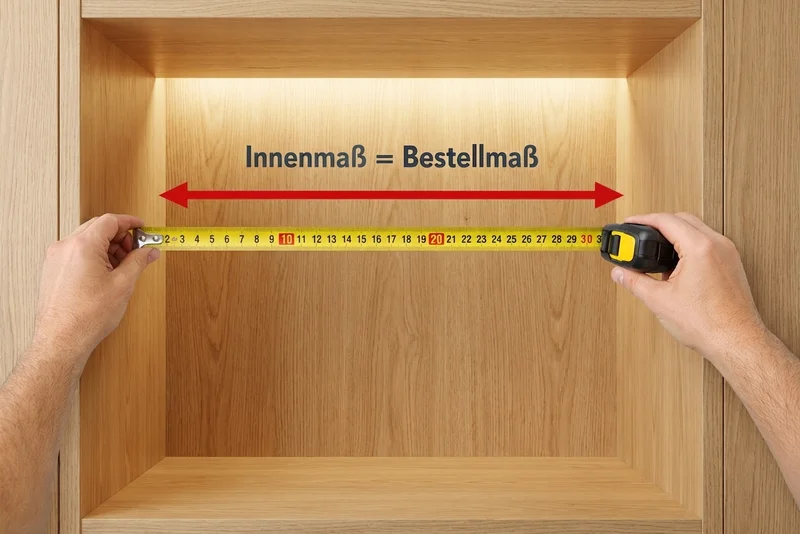
Measure the clear inside dimension from wall to wall. This inside dimension is exactly your order size; please enter it in millimetres.
Description
Clothes rail for wall, ceiling and shelf mounting
A stainless steel rail made from 33.7 × 2 mm tube, fixed to the wall, the ceiling or inside a shelf unit by two ball ring brackets. It needs no side panels and can hang freely in the room or in front of the wall. Made to your measurements in our workshop in Germany.
Design
Each bracket consists of a round plate (anchor plate), a 33.7 × 2 mm connecting tube and a ball ring through which the rail runs. A grub screw in the ball ring locks the rail in place. Cover rosettes conceal the screws on the wall or ceiling; after installation, fix them in place with a little silicone or hot glue.
The brackets are adjustable
Before tightening, the brackets can be moved freely along the rail. You therefore determine the fixing points only during installation: where the timber sits in a stud wall, where the masonry is load-bearing, where no cable or pipe runs. The rail may project beyond the brackets on the left and right.
Which bracket depth?
The bracket depth (B) is the overall dimension from the anchor plate to the end of the ball ring. The length (A) is the length of the rail.
- up to 27 cm: for shelf and ceiling mounting, when the rail hangs close beneath a shelf
- 27 to 30 cm: for wall mounting with clothes hangers; at 30 cm even wide jackets hang freely
- from 30 cm: for ceiling mounting, so that enough height remains for the hangers
Tube end of your choice
As the ends are visible, choose the end finish above: flat, domed or half-round plug, a domed cap that protrudes as a hanger stop, or a tube end ball.
Clothes hangers
The hook of a standard clothes hanger has an inner opening of around 35 mm. On the 33.7 mm tube it therefore sits steadily without tipping, yet still slides easily.
Material and surface
Stainless steel V2A, material 1.4301 (AISI 304), ground with grit 240. The brushed, silk-matt grain shows hardly any fingerprints and is forgiving of signs of use. The chromium in the steel forms a protective layer that renews itself after scratches; in living spaces V2A is permanently corrosion-resistant.
Ceiling mounting
On the ceiling, the bracket depth determines the height of the rail. With a room height of 250 cm and a bracket depth of 70 cm, the rail sits at 180 cm, leaving room beneath for long coats. Expansion anchors hold in concrete ceilings; with timber joist ceilings, screw into the joists.
Installation and substrate
Expansion anchors hold very well in concrete and solid brick. In perforated brick and aerated concrete, long anchors or injection anchors grip better; in plasterboard, screw into the studs of the substructure or use metal cavity anchors. Drill the hole deeper than the anchor length by the diameter of the anchor. You can select stainless steel screws and anchors directly above.
Care
A damp cloth is enough, with a little washing-up liquid if needed; always wipe in the direction of the grain. Avoid chlorine-based cleaners, scouring agents and steel wool. Fine scratches can be blended in with an abrasive fleece in the direction of the grain. More in our care instructions.
Product and safety information Steel Deal
Manufacturer: Steel-Deal UG (haftungsbeschränkt)Country of origin: Germany
Email: info@steel-deal.de
Frequently asked questions
Wie messe ich das richtige Bestellmaß für meine Garderobenstange?
Das Bestellmaß ist das Außenmaß Ihrer Garderobenstange inklusive Wandflansche. Geben Sie beim Bestellen dieses Maß an, wir passen die Rohrlänge automatisch an. Bei Unsicherheiten helfen wir Ihnen gerne weiter.
Welchen Durchmesser sollte ich für meine Garderobenstange wählen?
Handelsübliche Kleiderbügel haben Ø 35 mm Innendurchmesser. Wir empfehlen Stangen mit Ø 33,7 mm. So passen Standard-Kleiderbügel passgenau auf.
Was ist der Unterschied zwischen Wandmontage und Deckenmontage bei Kleiderstangen?
Wandmontage: Flansche an der Wand, Stange hängt horizontal. Deckenmontage: Flansche an der Decke, Stange hängt frei nach unten, ideal ohne geeignete Seitenwand.
Wann empfiehlt sich eine Deckenmontage statt einer Wandmontage?
Deckenmontage empfiehlt sich ohne Seitenwand, bei freischwebender Optik oder unter Dachschrägen ohne tragfähige Wand.
Welche Wandarten sind für die Montage einer Kleiderstange geeignet?
Massivwand mit Spreizdübeln, Gipskarton mit Hohlraumdübeln oder in Metallprofile, Holzwände direkt einschrauben. Hauptsache: sicherer Sitz.
Wie plane ich die Länge einer Kleiderstange für Wand- oder Deckenmontage?
Messen Sie das Außenmaß von Wandflansch zu Wandflansch. Das ist Ihr Bestellmaß. Wir fertigen auf Maß, auf den Millimeter genau.
Wie stabil ist eine Deckenmontage im Vergleich zur Wandmontage?
Decke und Wand sind bei korrekter Ausführung gleich stabil. Entscheidend ist der Untergrund und die richtige Dübel-Wahl.
Kann ich diese Kleiderstange auch unter einer Dachschräge montieren?
Ja, möglich. Für spezielle Schrägen empfehlen wir die Dachschrägen-Kleiderstange, speziell für diese Situation konstruiert.