
Stainless Steel Screws, Nuts and Standard Parts
| Description | Item no. | Dimension | Material | Unit | Price | Delivery time | ||
|---|---|---|---|---|---|---|---|---|
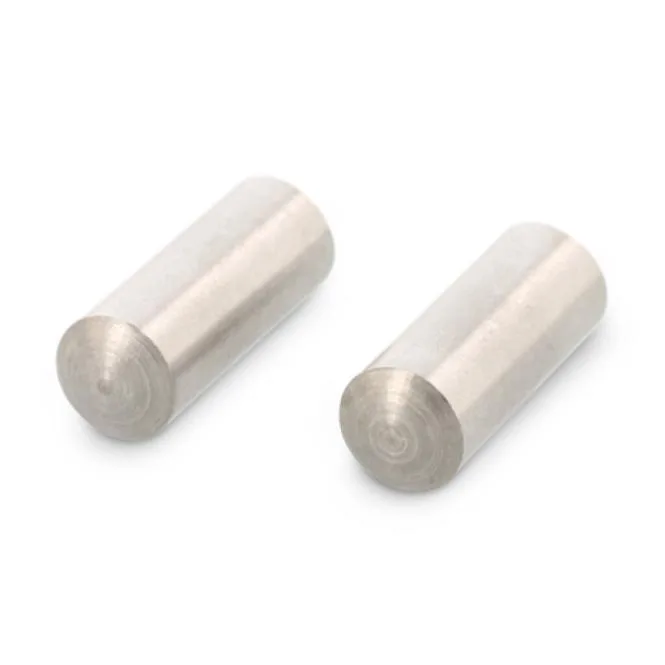 | Cylindrical pins form A, tolerance zone m6, DIN 7, stainless steel A4 and 1.43054 versions | from 0,12 EUR per piece | 3 to 5 working days | All versions | ||||
| 2,5m6 x 32 mm, 1.4305, VE 500 Stück | 0007225 32 | Diameter 2,5 mm, Length 32 mm | A1 | Packaging unit: 500 pieces | 0,1177 EUR per piece1 PU = 58,87 EUR | 3 to 5 working days | |
| 5m6 x 18 mm, 1.4305, VE 100 Stück | 000725 18 | Diameter 5 mm, Length 18 mm | A1 | Packaging unit: 100 pieces | 0,1631 EUR per piece1 PU = 16,31 EUR | 3 to 5 working days | |
| 12m6 x 80 mm, 1.4305, VE 25 Stück | 0007212 80 | Diameter 12 mm, Length 80 mm | A1 | Packaging unit: 25 pieces | 1,93 EUR per piece1 PU = 48,33 EUR | 3 to 5 working days | |
| 10m6 x 70 mm, A4, VE 50 Stück | 0007410 70 | Diameter 10 mm, Length 70 mm | A4 / V4A | Packaging unit: 50 pieces | 1,85 EUR per piece1 PU = 92,26 EUR | 3 to 5 working days | |
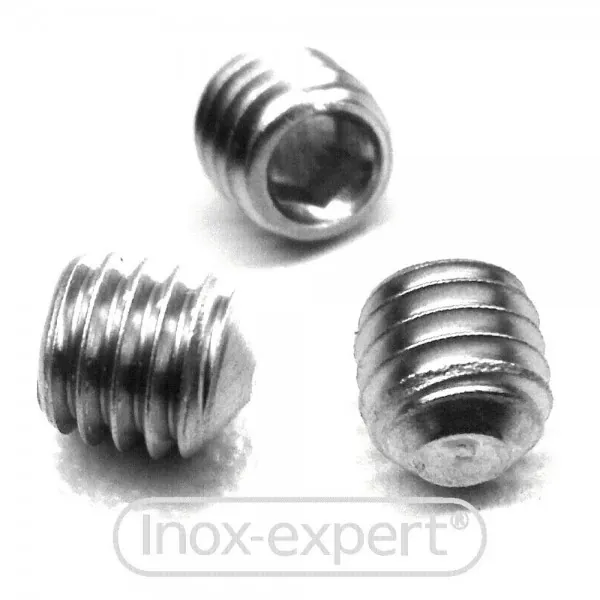 | Grub screws M6 x20 mm, flat point, stainless steel A4 | DIN916-M6X20 | Thread M6, Length 20 mm | A4 / V4A | single | 0,26 EUR per piece | 3 to 5 working days | |


Screws, nuts, washers, bolts, pins, rivets, retaining rings and other standard parts in stainless steel to DIN, ISO and manufacturer standards. Each series groups the dimensions of one standard; article number, material and packaging unit are given for every version.
Choosing stainless steel standard parts correctly
Three things matter in the selection: the standard, which defines shape and dimensions, the steel grade, which determines corrosion resistance, and the strength class. The subcategories lead directly to screws, nuts, washers, bolts, pins, concrete screws as well as rings, rivets and clamps.
A1, A2 or A4: the steel grade
ISO 3506 classifies stainless steels for fasteners by their microstructure into austenitic (A), martensitic (C), ferritic (F) and duplex (D). The range mainly comprises these grades:
| Grade | Material | Property |
|---|---|---|
| A1 | 1.4305 | Free-cutting steel with sulphur, easy to machine, lower corrosion resistance; not for chloride environments |
| A2 | 1.4301 | Commonly used stainless steel for fasteners; normally not suitable for permanent contact with sea water, de-icing salt or swimming pool atmosphere |
| A4 | 1.4401 | Alloyed with molybdenum, considerably more corrosion resistant, higher resistance to pitting and crevice corrosion |
| A5, often counted as A4 | 1.4571 | Stabilised with titanium, properties as A4, higher temperature resistance |
Even A4 reaches its limits in many marine environments and in swimming pools with chloride-containing cleaning agents; there, duplex or more highly alloyed steels may be necessary. Between different stainless steels such as A2 and A4, no bimetallic corrosion occurs, as long as the less resistant material is adequate for the place of use.
Strength classes
Screws made of austenitic stainless steel carry the strength classes 50, 70 or 80 under ISO 3506 Part 1, with a minimum tensile strength of 500, 700 or 800 N/mm². Classes 70 and 80 apply up to M24. Nuts are covered by ISO 3506 Part 2. Screws and nuts from M5 are marked with the manufacturer's mark, steel grade and strength class, for example with steel grade A2 and class 70.
DIN and ISO
Many DIN standards for fasteners have been replaced by ISO standards, for instance DIN 933 by ISO 4017, DIN 934 by ISO 4032 and DIN 125 by ISO 7089. For hexagon head screws, the across-flats dimensions of M10, M12, M14 and M22 change; hexagon nuts to ISO 4032 have the same new across-flats dimensions and are taller from M5 to M39. Details are given in the subcategories.
Installation
Stainless steel threads can seize when tightened; clean parts and lubrication before screwing together help. The screw should be made of a more noble material than the component. Where stainless steel meets aluminium or galvanised steel in damp conditions, plastic insulating washers or sleeves separate the materials.